
A Recent Tragedy
In mid-February, I received devastating news: a colleague and experienced electrician is currently fighting for his life. He has been in a coma for nearly three weeks following a battery site incident.
The details are a stark warning to our industry. After a faulty battery was repaired and reinstalled, it entered a fault mode and began venting smoke. Both the electrician and the fire department responded. The electrician entered the area to disconnect the supply so the fire department could safely begin suppression. After exiting, he went for a medical check-up, collapsed, and remains in critical condition with blood oxygen saturation levels around 50%.
This tragedy hits home—not just because I know the individual’s expertise, but because it highlights the life-or-death nature of the discussions we are currently having with the Department of Employment and Labour regarding competency and the protection of our workforce.
What Could Have Changed the Outcome?
While a full investigation is pending, we can identify several critical measures that significantly reduce risk in these environments:
- Routine Maintenance: Systematic testing to identify simple faults before they escalate.
- Manufacturer-Specific Training: Understanding the unique operational nuances of different battery brands.
- Integrated Fire Protection: Utilizing systems designed to halt thermal runaway in its tracks.
- Quality Assurance: Using certified products where the Battery Management System (BMS) reliably cuts supply during a fault.
- Specialized PPE: Mandating the use of respirators and fire-rated suits when approaching compromised units.
- Correct Suppression: Using only approved fire extinguishers designed to cool and coat lithium fires.
- Industry Standardization: Unified BMS and battery safety requirements across the sector.
Understanding the Danger: Thermal Runaway
To respect the risk, we must understand the science of the failure. Lithium batteries fail through a phenomenon known as thermal runaway. According to Underwriters Laboratories (UL), this is an uncontrollable, self-heating state.
Thermal runaway results in:
- Violent Venting: Ejection of gas, shrapnel, and particulates.
- Extreme Heat: Temperatures that exceed the limits of standard firefighting gear.
- Toxic Smoke & Fire: A self-sustaining chemical blaze.
This state is triggered by physical damage, overcharging, short-circuits, or extreme ambient temperatures.
The Chemical Threat
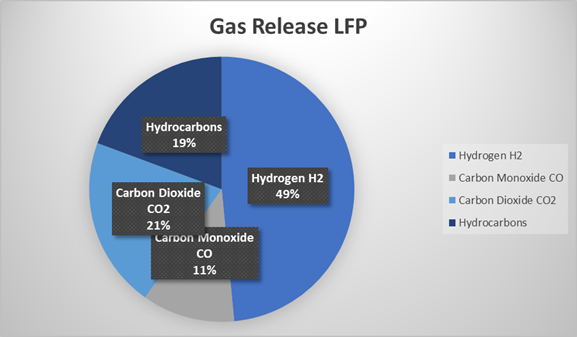
When a Lithium Iron Phosphate (LFP) battery enters thermal runaway, the Fire Safety Research Institute (FSRI) has found it releases a lethal cocktail of gases:
- Hydrogen (H2): 48.4%
- Carbon Dioxide (CO2): 20.8%
- Hydrocarbons: 19.3%
- Carbon Monoxide (CO): 11.3%
The implications are terrifying. Hydrogen is highly explosive, with a Lower Explosive Limit (LEL) of only 4% and an Upper Explosive Limit (UEL) of 70%. Furthermore, the high concentration of Carbon Monoxide and other hydrocarbons makes the air not just flammable, but lethal to inhale.
The Bottom Line
As electrical contractors, we cannot afford complacency. We must stay ahead of the technology and perform rigorous, environment-specific risk analysis on every job. Our lives, and the lives of our teams, depend on it.
By Anthony Schewitz – Regional Director: Highveld


